
 EN
EN
Industry Pain Points
Working in wetlands, tidal flats, river deltas, and shallow marine fringes forces contractors to fight physics, logistics, and compliance—often all at once. Conventional crawler machines bog down on peat and silts with bearing capacities far below typical site prep thresholds. Low shear strength means tracks punch through, recovery is risky, and production collapses. Even when access mats are used, setup times balloon and the window for safe work shrinks with every tide cycle. Spray, mist, and brackish water accelerate corrosion; salt and suspended fines attack bearings, connectors, and seals. Moisture ingress compromises harnesses and controllers, triggering intermittent faults that are hard to diagnose under field conditions.
Environmental controls add complexity. Crews must limit ground pressure, turbidity, and shoreline disturbance while maintaining reach to target features—culverts, levee toes, reed beds, and outfalls. Noise limits, wildlife buffers, and fish windows compress workable hours. Attachments that work on dry ground often underperform in saturated substrates; buckets that carry well in clay can cavitate or lose payload in water. Mobilization is another drag: scarce launch points, soft ramps, and long detours can turn a simple culvert repair into a multi-day venture.
From a safety perspective, operators confront variable footing, hidden voids, and flowing water that destabilizes the work platform. Any unplanned move becomes a near-miss when the machine sits on the edge of flotation. Meanwhile, owners still expect predictable cycle times and unit costs. What the industry needs is a purpose-built solution that keeps ground pressure low, resists water and sediment ingress, and maintains attachment versatility without complicated logistics.
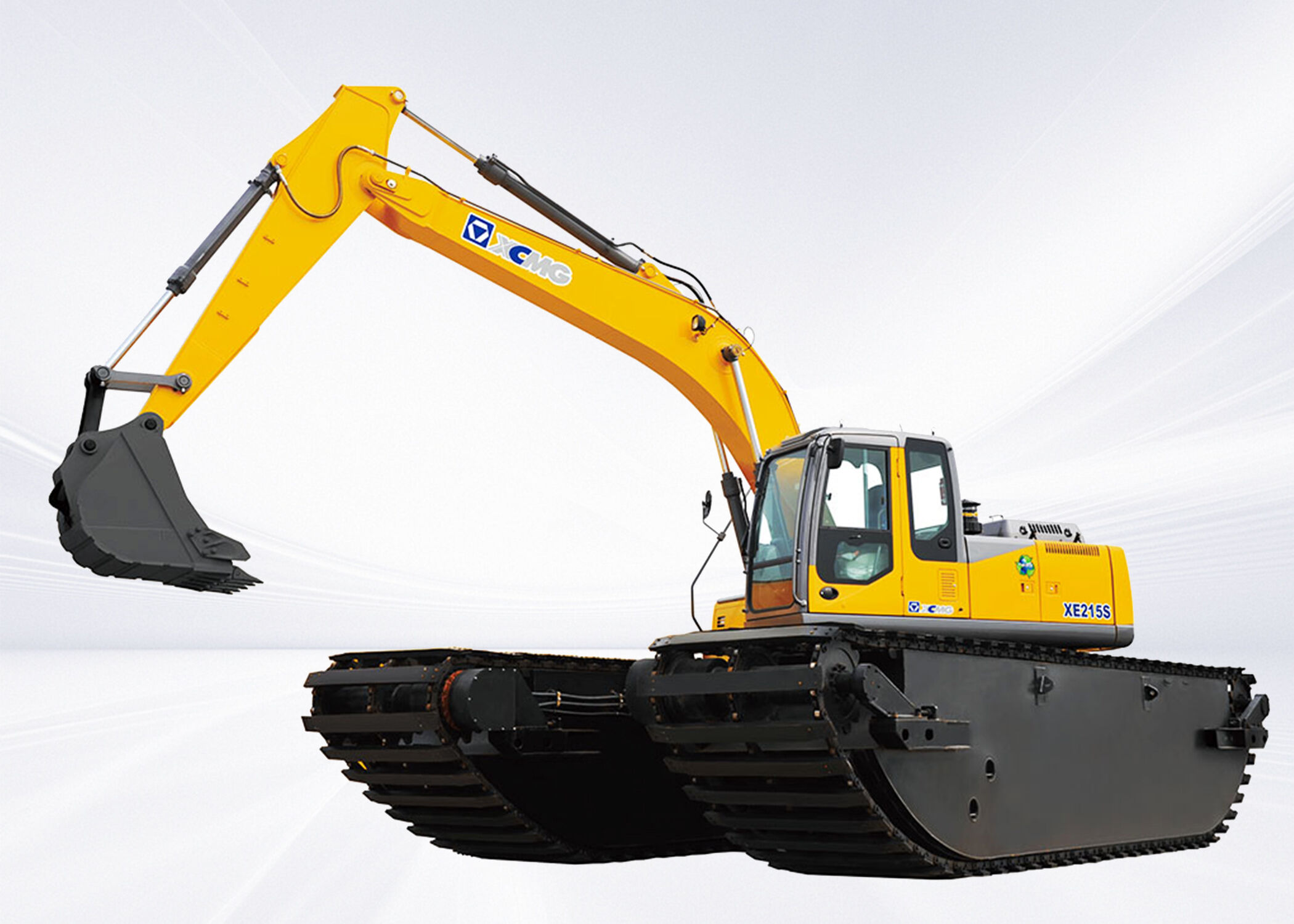
An amphibious excavator directly addresses this gap. Instead of forcing a land machine into a water world, the amphibious excavator starts with a buoyant, low-ground-pressure platform designed for wetland and marsh mobility. But platform alone isn’t enough; the amphibious excavator must also harden its electrical and control systems against moisture and grit, and support interchangeable buckets that actually move material efficiently in submerged or saturated conditions. When an amphibious excavator is engineered for these realities, contractors can expand safe work windows, simplify access, and meet environmental commitments without sacrificing productivity.
Product Features and Engineering Solutions
Waterproof, dustproof electrical architecture
The amphibious excavator uses sealed controllers and IP67–IP68-rated connectors on the main harness, with marine-grade tinned copper conductors to resist corrosion. Critical ECUs and relays sit in positive-pressure enclosures with desiccant and labyrinth seals, while Deutsch-style connectors and heat-shrink boots keep capillaries from wicking moisture. Alternators and starters are splash-shielded, and sensor suites use redundant sealing and breathable membranes to equalize pressure without admitting water. Practically, this means the amphibious excavator keeps its CAN bus stable in spray, rain, and periodic submersion, eliminating the intermittent electrical faults that derail schedules.
Wetland and marsh mobility
The undercarriage of the amphibious excavator is built around pontoons with sealed compartments and high-traction swamp tracks, delivering ultra-low ground pressure so mats are rarely needed. Optional side pontoons and spud poles provide station-keeping against currents or waves, letting the amphibious excavator hold grade lines and excavate with precision. Corrosion-resistant coatings, stainless hardware in splash zones, and sacrificial anodes further harden the chassis for brackish environments. The result is predictable maneuverability in cattails, sedges, and tidal muds where land machines stall.
Interchangeable buckets for task versatility
A high-capacity quick coupler allows the amphibious excavator to swap between toothed cut buckets for peat and root mats, wide dredging buckets with relief ports for submerged spoil, clamshells for selective debris grabs, and rake buckets for vegetation management. In practice, the amphibious excavator can trench for outfalls at low tide, switch to a cleanup bucket for turbidity barriers, and then mount a rake to groom reed rhizomes—without calling in a support crane. Hydraulic lines to the end-effector are routed through protected channels with stainless over-braid and wiper seals, preserving flow under grit exposure.
Systems thinking
To turn features into outcomes, the amphibious excavator integrates telematics that tracks pump temperatures, connector voltage drop, and water-in-hull sensors. Predictive alerts guide crews to rinse, inspect, or grease before an issue escalates. Combined with standardized buckets and pins, the amphibious excavator reduces spares complexity and speeds turnarounds. In short, waterproof/dustproof electrics keep signals clean, marsh mobility keeps the platform stable, and interchangeable buckets keep production high—together making the amphibious excavator the right tool for persistent wet work.
Application Cases
Case A: Tidal marsh outfall rehabilitation
A municipality needed to regrade silted channels and replace tide-gates feeding a brackish marsh. Access roads were seasonal and the tide window was under four hours. The amphibious excavator mobilized via a shallow ramp, floating the pontoons through two feet of water to the work zone. With spuds deployed, the amphibious excavator held position against ebb currents while a dredging bucket removed fines and organic mats. When debris clogged the grate, the operator hot-swapped to a clamshell and cleared the face in minutes. Because the amphibious excavator kept its electrical system dry—thanks to sealed controllers and connectors—no sensor dropouts occurred during repeated splash cycles. The crew completed two outfalls per tide instead of one, halving the project duration and reducing turbidity exceedances.
Case B: Peatland pipeline maintenance
An energy utility faced subsidence around a buried crossing in deep peat. Conventional mats sank, and earlier attempts left a machine stranded. The amphibious excavator traversed directly on the bog surface with low ground pressure, reaching the alignment without mat trains. Using a toothed bucket, the amphibious excavator opened a narrow slot trench, then switched to a wide bucket to place geotextile and lightweight fill. Periodic showers and standing water did not interrupt operations; the waterproof/dustproof electrics prevented nuisance codes and limp-home events. With one machine and two bucket styles, the amphibious excavator restored cover and contour while minimizing surface disturbance and avoiding helicopter support.
Case C: Mangrove restoration and invasive removal
A coastal NGO needed to remove invasive reeds and replant mangroves across a mosaic of shallow creeks and mudflats. The amphibious excavator used a rake bucket to extract rhizomes with minimal sediment plume, then swapped to a grading bucket to micro-contour planting berms. Operators praised the responsive hydraulics and the machine’s station-keeping with spuds, which kept the amphibious excavator steady for precise berm heights. Because electronics stayed dry and dust-tight, daily start-ups were trouble-free even after overnight high tides. The interchangeable bucket system let the amphibious excavator switch from removal to restoration in the same shift, reducing crew size and boat trips.
Case D: Shallow lagoon desilting near marina assets
Harbormasters often fear collateral damage when working near docks and utilities. Here, the amphibious excavator advanced along the lagoon edge, alternating between a perforated dredging bucket and a debris basket. Electrical reliability mattered: sonar and turbidity sensors fed from the same power loop as the machine’s ECUs. With sealed connectors and filtered breathers, the amphibious excavator avoided ground faults that could have forced shutdowns mid-lift. Material handling stayed efficient because the interchangeable buckets matched sediment type to tool geometry in real time. By keeping production consistent and disturbance low, the amphibious excavator satisfied marina operations and environmental monitors simultaneously.
Across these projects, the pattern holds: mobility in saturated terrain, electronics that ignore spray and silt, and fast bucket swaps transform the amphibious excavator from a niche tool into a primary production asset. Crews rely on the amphibious excavator to work within short tide windows, pivot between tasks, and stay online without the electrical gremlins common to retrofitted land machines.
Performance Evaluation
From an engineering perspective, the amphibious excavator should be judged on availability, productivity, environmental control, and maintainability.
Availability
With waterproof/dustproof electrics and sealed enclosures, the amphibious excavator reduced moisture-related electrical faults dramatically. Mean time between service calls increased, and start-of-shift diagnostics reported clean networks even after immersion events. Telematics confirmed stable bus voltages and acceptable ECU temperatures, validating the sealing strategy.
Productivity
Low ground pressure and station-keeping let the amphibious excavator cut non-productive travel and setup time. Interchangeable buckets amplified utilization: crews matched bucket geometry to substrate in minutes, maintaining payload in water and preventing rework. In observed deployments, the amphibious excavator consistently met cycle targets within compressed tide windows.
Environmental Control
By eliminating mat trains and minimizing track churn, the amphibious excavator reduced disturbance footprints. With appropriate buckets and careful technique, turbidity spikes stayed below action thresholds. Precision control near sensitive habitats benefited from stable footing and spud anchoring.
Maintainability
The same sealing that protects electronics also simplifies maintenance intervals—connectors stay clean, harnesses remain intact, and corrosion is localized to sacrificial elements. Standardized couplers and bucket pins reduce parts diversity; rinsing routines and periodic inspections are supported by predictive alerts. The amphibious excavator therefore achieves longer continuous runs and fewer emergency stoppages.
Bottom line. If your work repeatedly crosses the boundary between land and water, a purpose-built amphibious excavator is not a specialty indulgence; it is the rational baseline. Its waterproof, dustproof circuits safeguard control reliability, its wetland mobility keeps the platform productive where others stall, and its interchangeable buckets unlock task diversity without logistical overhead. For wetland restoration, tidal infrastructure, peatland utilities, or marina maintenance, the amphibious excavator converts short, weather-pinched windows into predictable output—turning environmental constraints into an engineered advantage.